How to Import Material Symbols into Figma
Google's variable-axis icon system.
What is Material Symbols?
Material Symbols is Google's successor to Material Icons, built on a variable font with fill, weight, grade, and optical size axes. Static SVG exports at fixed settings are available for teams that don't want to work with the variable font directly.
- Maintained by
- License
- Apache 2.0
- Icon count
- 3,000+
- Formats available
- SVG, Variable web font, Android XML
Extremely widely used given both its size and Google's backing, especially in products already following Material Design conventions.
Strengths
- By far the largest vocabulary of any set on this page — very unlikely to be missing an icon
- The variable-axis model gives fill/weight/grade/optical-size control other libraries don't offer at all
- Backed and actively maintained by Google, with strong long-term stability
Worth knowing
- No official Figma Community file — getting the full set into Figma means exporting static SVGs at chosen axis settings first
- The variable-font model itself doesn't translate into Figma at all; only fixed-setting SVG exports do, so some of the format's flexibility is lost in the design file
Good fits
- Teams already using Material Design conventions elsewhere in the product
- Design systems that want fine-grained weight/fill control across a huge shared icon vocabulary
- Cross-platform products (Android + web) wanting one shared icon source
Ways to import Material Symbols into Figma
Three realistic routes, compared honestly — including where VectaGrid genuinely isn’t the best fit.
Download the official SVGs
Pros
- Full control over exactly which icons you take
- Always current — no snapshot to fall out of date
- Works even when no official Figma file exists
Cons
- Fully manual from there — each SVG needs converting to a component by hand
- No built-in variant structure; you're building that yourself
- Tedious past a handful of icons
Best for: Grabbing a handful of specific icons, or teams building a fully custom variant structure from scratch.
Browse Material Symbols on GitHubFigma plugins (no official Community file exists)
Pros
- The Iconify plugin indexes this set alongside 150+ others, searchable in-editor
- Good for grabbing icons one at a time while designing
Cons
- Material Symbols doesn't publish its own official Community file
- Not suited to importing the whole set as a structured library
Best for: Occasional single-icon use rather than building a full library.
Bulk import with VectaGrid
Pros
- Imports the whole downloaded Material Symbols set — or any subset — in one pass
- Normalizes every icon to a consistent frame automatically
- Builds a Color=Black/White variant set per icon, matching Figma's own one-component-per-icon guidance
- Same workflow whether the source is this library, another one, or your own proprietary icons
Cons
- Free plan caps at 100 icons per import; unlimited is a one-time $39
- Built for monochrome UI icon sets — doesn't preserve original multi-color artwork
Best for: Importing all of Material Symbols (or a large subset) as a properly structured component library — especially when combining it with your own icons.
See how VectaGrid works →Walkthrough: importing Material Symbols as a structured component library
The steps below cover the bulk-import route in detail, since it’s the one that isn’t already self-explanatory. Steps 1-2 apply regardless of which import method you end up using.
- 1
Download the SVG source files
Clone or download Material Symbols’s GitHub repository and locate its raw SVG folder — most icon library repos keep source SVGs in a dedicated
icons/orsvg/directory rather than only shipping compiled framework packages — check the repo’s README if it’s not obvious. - 2
Optimize the files first (optional, recommended)
Icon exports often carry unnecessary editor metadata and excess path precision. Running them through the free SVG optimizer first keeps the source files — and the resulting Figma file — lighter. Not required, but it’s a five-minute step that avoids a heavier design file later.
- 3
Select the files in VectaGrid
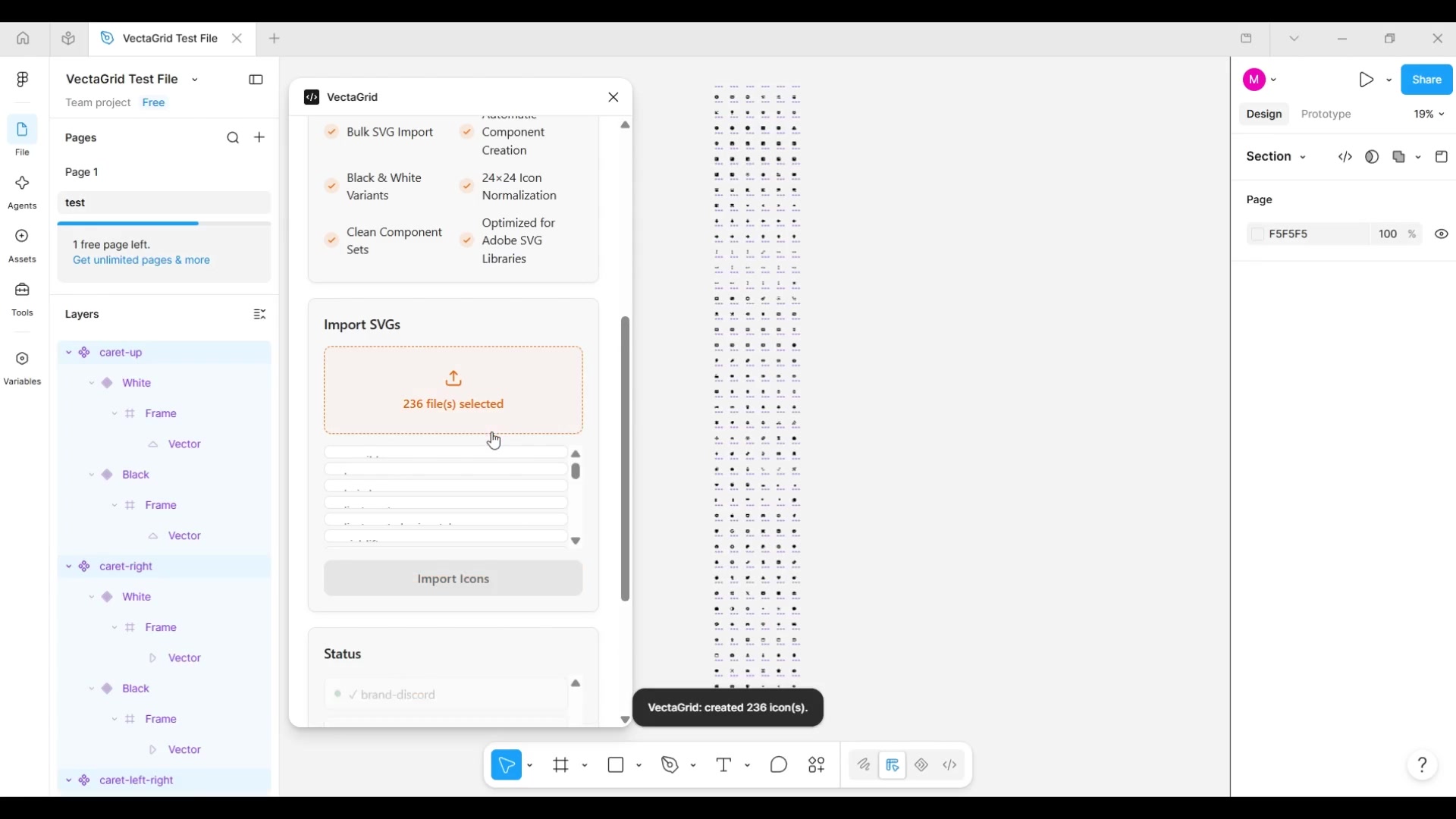
Open VectaGrid in Figma, click the dropzone, and select the SVG files or folder — one file or the entire set at once. Free plan covers up to 100 icons per import; larger sets need Pro or a couple of batched imports.
- 4
Click Import Icons
Each SVG is parsed, centered, and normalized into a 24×24 frame regardless of its original viewBox, then cloned into
Color=BlackandColor=Whitevariants combined into one component set per icon — matching the one-component-per-icon structure Figma’s own documentation recommends. - 5
Review, then publish as a team library
Every generated component set lands arranged in a clean grid on the current page — spot-check a handful of icons, then publish the page as a Figma team library the same way you would for any other component set.
Troubleshooting
- Icons look inconsistently sized after import elsewhere in your file: that’s the source viewBox differences that Material Symbols’s files can carry — VectaGrid’s normalization step handles this automatically, so re-check you imported through it rather than a manual drag-and-drop.
- Hit the 100-icon free-plan cap: split the import into batches, or unlock unlimited imports with the one-time Pro upgrade if you’re importing the full set regularly.
- Need a color variant beyond Black/White: VectaGrid currently generates Black/White pairs — for a specific brand color, recolor the generated components after import, or maintain that variant manually alongside the generated set.
Comparing the three workflows
The same tradeoffs apply whether you’re importing Material Symbols or any other SVG icon set — this is about the method, not the specific library.
| Dimension | Manual import | Official file | VectaGrid |
|---|---|---|---|
| Setup time | Slow — one icon at a time | Fast — duplicate and go | Fast — one bulk import |
| Scales to hundreds of icons | No — linear manual effort per icon | Only as well as the source file scales | Yes — designed for bulk import |
| Real components (not layer groups) | Only if you manually convert each one | Yes | Yes |
| Consistent frame/variant structure | Only if you build it yourself | As shipped by the library maintainer | Automatic — normalized frame + Color variant |
| Stays current with upstream updates | Yes, if you re-download | No — duplicated snapshot | Yes, if you re-import updated source files |
| Works with your own proprietary icons | Yes | No — official file is that library only | Yes — same workflow for any SVG source |
| Team library maintenance | Manual, ongoing | Manual re-duplication for updates | Re-import + publish, same as any component update |
| Cost | Free | Free | Free up to 100 icons, $39 one-time for unlimited |
Material Symbols FAQ
No — Material Symbols is the newer variable-font-based system with adjustable fill/weight/grade/optical size. Material Icons (the older static set) still exists and is still supported, but Google's current guidance points new projects to Symbols.
Related guides
How to Convert SVG Icons to Figma Components
The manual copy-paste method, why it falls apart past a handful of icons, and how to do it properly at scale.
How to Build a Figma Icon Library for Your Design System
Variants, consistent framing, and naming conventions — what actually makes an icon library production-ready.
How to Bulk Import Hundreds of SVG Icons into Figma
Importing an entire icon set at once instead of one file at a time, and what to check before you do.
Related icon libraries
Skip the manual work — VectaGrid does this automatically.
Drop in a folder of SVGs and get a normalized, variant-ready component library in seconds. Free for up to 100 icons.
Questions first? Email support@mosherlabs.dev or see the full VectaGrid page.